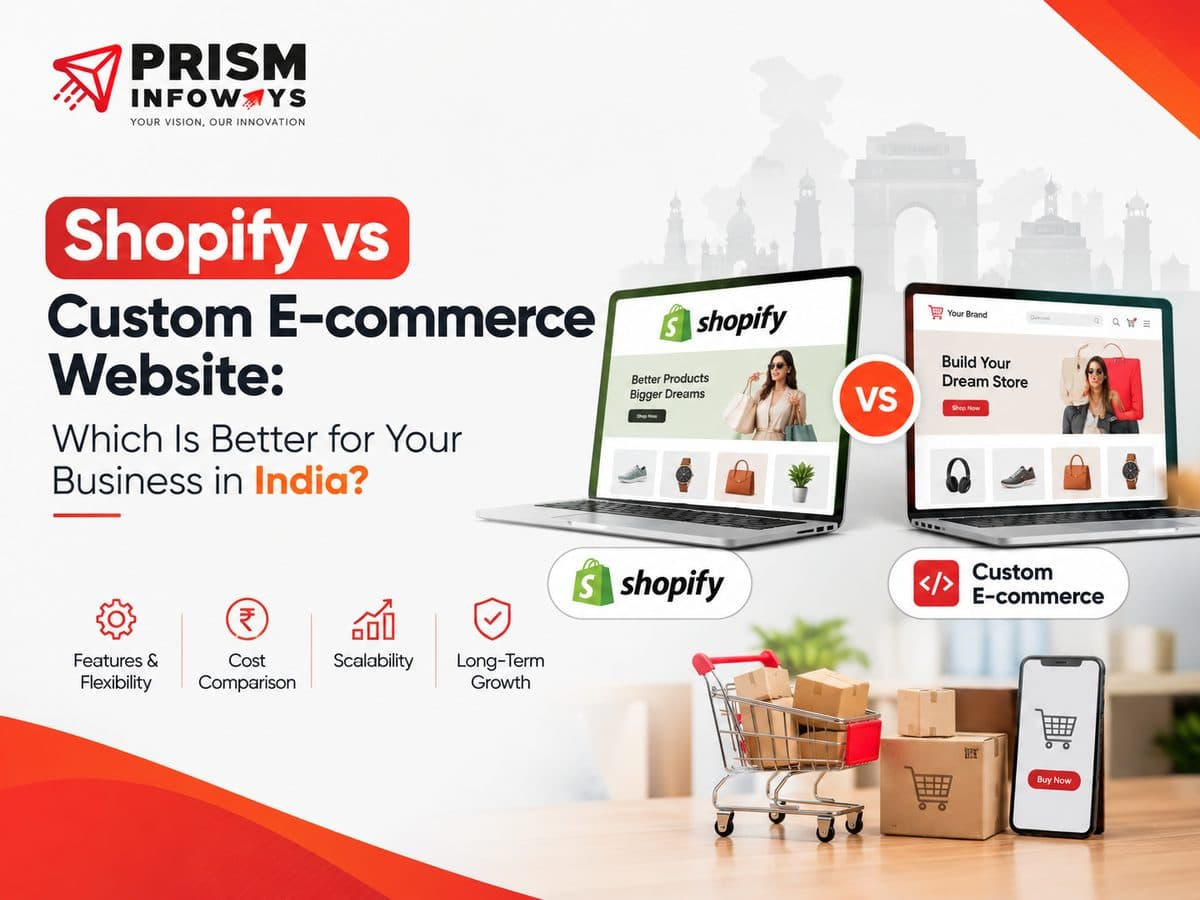
Shopify or a custom e-commerce website? Compare cost, Shopify fees in India, design, payments and COD, SEO and scalability to choose the right platform for your online store.
Planning to sell online? One of the first decisions you will face is Shopify vs custom e-commerce website. Both options can help you build a successful online store in India, but they work in very different ways. Shopify is a ready-made platform where you pay a monthly fee and launch quickly. A custom e-commerce website is built from scratch around your exact business needs.
So which one should you pick? The answer depends on your budget, your growth plans, and how much control you want over your store. In this guide, we compare both options in plain English, covering cost, design, payments, SEO, and scalability, so you can decide with confidence.
Quick Answer: Shopify or Custom?
- Choose Shopify if you are a new or small business, have a limited budget, and want to launch within days.
- Choose a custom e-commerce website if you need unique features, full ownership of your code and data, deep integrations (ERP, CRM, logistics), or expect high order volumes.
- Many Indian brands do both: they start on Shopify to test the market, then move to a custom website once they grow.
What Is Shopify?
Shopify is a hosted e-commerce platform. You sign up, pick a theme, add your products, connect a payment gateway, and your store is live. Shopify takes care of hosting, security, and software updates for you.
Its biggest strength is speed. You do not need a developer to get started. Thousands of apps let you add features like reviews, WhatsApp chat, or loyalty points. The trade-off is that you are working inside Shopify’s rules and paying for it every month.
What Is a Custom E-commerce Website?
A custom e-commerce website is built specifically for your business using technologies such as React, Next.js, Node.js, Laravel, or Python. It runs on your own server or cloud account, and you own the code. Professional e-commerce website development lets you design every page, checkout step, and backend workflow exactly the way your business works.
This approach takes more time and a higher upfront investment. In return, you get complete flexibility, no platform lock-in, and no per-sale platform fees.
Shopify vs Custom E-commerce Website: Side-by-Side Comparison
- Launch time: Shopify – A few days to 2 weeks | Custom website – 6 to 16 weeks (depends on features)
- Upfront cost: Shopify – Low | Custom website – Medium to high
- Monthly cost: Shopify – Plan fee + apps + GST | Custom website – Hosting + maintenance
- Extra fee per sale: Shopify – Yes (in India) | Custom website – No platform fee
- Design freedom: Shopify – Limited to themes | Custom website – Unlimited
- Custom features: Shopify – Through paid apps | Custom website – Built exactly as needed
- Code and data ownership: Shopify – Rented platform | Custom website – You own everything
- Best for: Shopify – Startups, small catalogues | Custom website – Growing and established brands
Key Differences Explained
1. Cost: Shopify Pricing in India vs Custom E-commerce Website Cost
Shopify pricing in India looks affordable at first. The Basic plan is roughly ₹1,499 per month when billed yearly, Grow is about ₹5,599, and Advanced is about ₹22,680. All plans attract 18% GST. Prices change from time to time, so always check Shopify’s official pricing page.
There is also a hidden cost. Shopify Payments is not available in India, so Indian sellers pay an extra third-party transaction fee on every order (around 2% on the Basic plan, lower on higher plans). This is on top of your payment gateway’s own charges. Paid themes and apps add more.
Example: if your store sells ₹5 lakh worth of products a month on the Basic plan, a 2% fee means about ₹10,000 every month goes to Shopify, before gateway fees.
The custom e-commerce website cost works differently. You pay a one-time development fee, which typically ranges from ₹1.5 lakh for a simple store to ₹10 lakh or more for complex platforms. After that, you only pay for hosting and maintenance. For high-volume stores, a custom build is often cheaper over three to five years.
2. Design and Brand Experience
Shopify themes look professional, but many stores end up looking similar. Deeper changes, especially to the checkout page, are restricted unless you move to the expensive Shopify Plus plan.
With a custom website, every element is designed for your brand and your customers. You can create unique product pages, custom bundles, or a one-page checkout that improves conversions.
3. Payments, COD and Indian Customer Needs
Indian shoppers have specific habits. They love UPI, many still choose Cash on Delivery (COD), and businesses need proper GST invoices. Shopify supports Indian gateways like Razorpay and Cashfree, and apps for COD and shipping, but each app adds cost and complexity.
A custom build can include these features directly. For example, you can add COD verification through OTP or WhatsApp to reduce fake orders and return-to-origin (RTO) losses, or connect directly with courier partners and your accounting software.
4. Scalability and Speed
Shopify handles hosting and traffic spikes well, which is a real advantage during festive sales. However, installing many apps can slow your store down.
A custom website needs a good cloud setup, but it can be optimised for speed from day one. When built well, it scales smoothly as your products, users, and orders grow.
5. SEO and Data Ownership
Shopify offers decent SEO basics, but it has fixed URL patterns like /products/ and /collections/ and limited technical control. A custom website gives you full control over URLs, schema markup, page speed, and site structure, which all help with Google and AI search visibility.
Ownership matters too. On Shopify, you rent the platform. With a custom website, your code and customer data stay with you. This also makes it easier to control how data is stored and handled under India’s DPDP Act.
When Should You Choose Shopify?
- You are launching your first online store in India and want to test demand.
- Your budget is small and you need to go live quickly.
- You sell a simple catalogue with standard features.
- You do not have a technical team and want minimal maintenance.
When Is a Custom E-commerce Website Better for Indian Businesses?
- Your monthly sales are high and transaction fees are eating into profits.
- You need special features like B2B pricing, multi-vendor marketplaces, subscriptions, or custom product builders.
- You want to integrate ERP, CRM, inventory, or warehouse systems.
- Your brand experience is a key part of your competitive advantage.
- You want full ownership of your platform, code, and customer data.
Step-by-Step Guide: How to Choose the Best E-commerce Platform for Your Business in India
Follow these simple steps to make the right choice:
- Define your business goals. Are you testing an idea, or building a long-term brand? Short-term tests suit Shopify. Long-term growth often suits custom.
- Estimate your order volume. Project your monthly sales for the next two to three years. Higher volume makes per-sale fees more expensive.
- Calculate the total 3-year cost. Add plan fees, GST, transaction fees, and app costs for Shopify. Compare it with development, hosting, and maintenance costs for a custom website.
- List your must-have features. Write down every feature you need. If most require paid apps or workarounds, custom is likely the better fit.
- Check Indian payment and shipping needs. Confirm support for UPI, COD, GST invoicing, and your preferred courier partners.
- Plan for growth and ownership. Think about future integrations, international selling, and how important owning your data is.
- Talk to an experienced development partner. A good agency will give you an honest recommendation, even if that means starting with Shopify.
Frequently Asked Questions
1. Is Shopify good for small businesses in India?
Yes. Shopify is a good choice for small businesses in India that want to launch quickly with a low budget. It is easy to use and needs no coding. Just factor in GST, app costs, and the extra transaction fee when planning your profits.
2. How much does a custom e-commerce website cost in India?
A custom e-commerce website in India typically costs between ₹1.5 lakh and ₹10 lakh or more. The final price depends on features, design complexity, integrations, and the number of products. Ongoing hosting and maintenance are extra.
3. Does Shopify charge transaction fees in India?
Yes. Because Shopify Payments is not available in India, sellers pay a third-party transaction fee on each sale, which is around 2% on the Basic plan and lower on higher plans. This is in addition to your payment gateway’s charges.
4. Which is better for SEO: Shopify or a custom e-commerce website?
Both can rank well. However, a custom e-commerce website offers more SEO control, including flexible URLs, advanced schema, and better speed optimisation. Shopify is fine for basic SEO but has technical limits.
5. Can I move from Shopify to a custom e-commerce website later?
Yes. Many Indian brands start on Shopify and migrate to a custom platform as they grow. Products, customers, and orders can be moved, and proper URL redirects protect your search rankings during the switch.
Conclusion
There is no single winner in the Shopify vs custom e-commerce website debate. Shopify is perfect for launching fast with a small budget. A custom website is the smarter long-term investment when you need flexibility, lower per-sale costs, and full ownership.
The best choice is the one that fits your business today and supports where you want to be in three years.
Not sure which option is right for you? The team at Prism Infoways builds fast, secure, and scalable online stores for Indian businesses. Explore our e-commerce website development services and book a free consultation. We will help you pick the right platform and plan a store that grows with you.
Need Expert IT Solutions?
Ready to transform your business? Team up with Prism Infoways and harness cutting-edge technology for your growth.
Contact Us