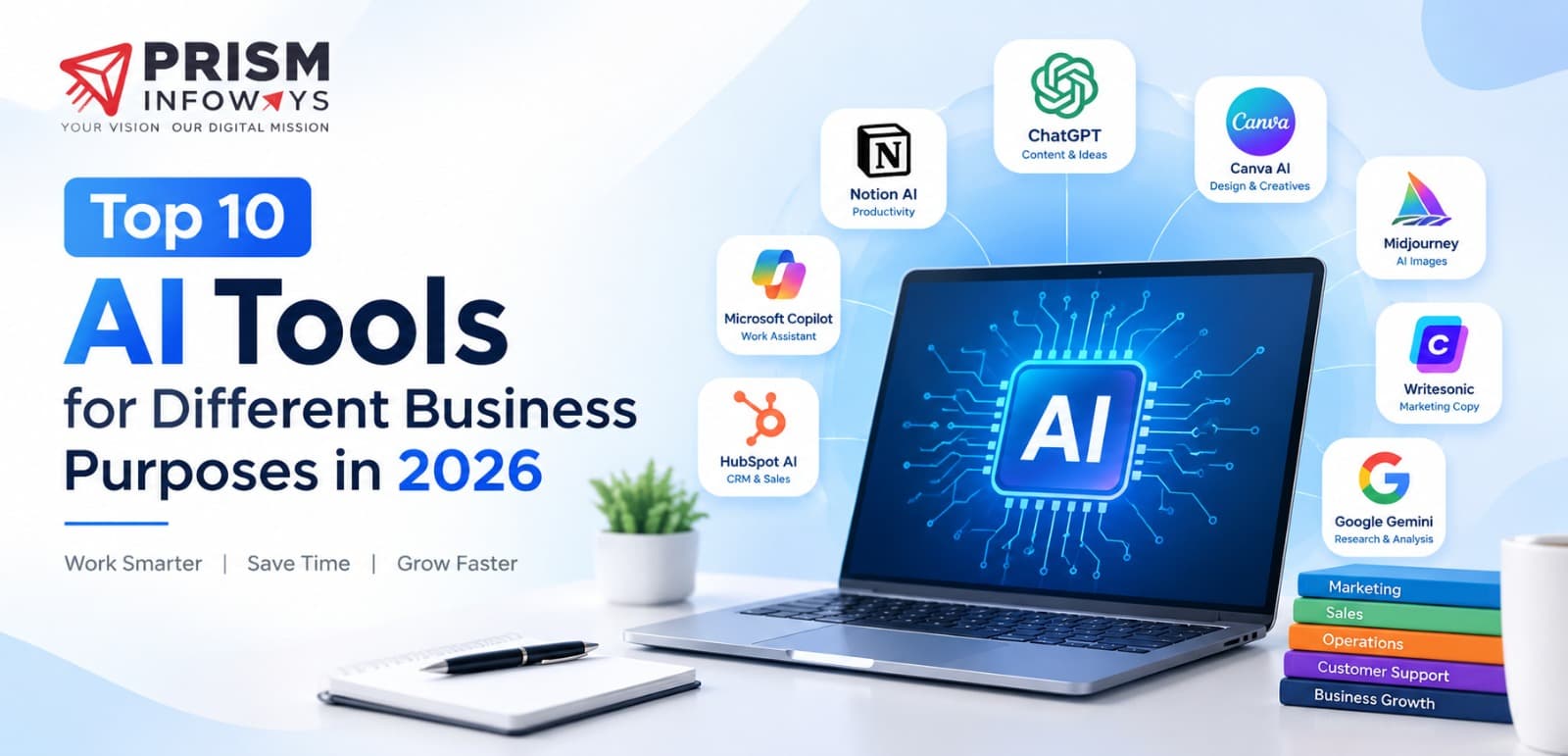
The best AI tools in 2026 depend on the job. Use ChatGPT, Claude or Gemini for writing and reasoning, Perplexity for sourced research, Canva and Midjourney for design, GitHub Copilot for coding, Zapier for automation, Semrush for SEO and ElevenLabs for voice. Pick one tool per purpose instead of one tool for everything.
Quick answer: The best AI tools in 2026 depend on the job. Use ChatGPT, Claude or Gemini for writing and reasoning, Perplexity for sourced research, Canva and Midjourney for design, GitHub Copilot for coding, Zapier for automation, Semrush for SEO and ElevenLabs for voice. Pick one tool per purpose instead of one tool for everything.
Artificial intelligence is no longer a single chatbot. Teams now use different AI tools for writing, research, design, code, marketing and automation. Choosing the wrong one wastes budget and time. This guide ranks ten proven tools by purpose, so you can match each one to a real business task.
At Prism Infoways, we help companies move from experimenting with AI to running it inside real products. If you want a custom setup, our AI solutions team can build it around your workflow.
How We Picked These AI Tools
We looked at four things: how well the tool does one clear job, how easy it is to start, how it fits into existing business software, and how safe it is with company data. Features and plans change often, so always check each vendor's current pricing before you commit.
The Top 10 AI Tools by Purpose
1. ChatGPT: Best for General Writing and Brainstorming
ChatGPT is the all-rounder. It drafts emails, outlines blogs, summarises documents, writes basic code and analyses spreadsheets. It works well as a first-draft partner for marketing teams and founders. Treat its output as a draft, then edit for accuracy and brand voice.
2. Claude: Best for Long Documents and Careful Reasoning
Claude handles long reports, contracts and codebases well and tends to give structured, thoughtful answers. It suits analysts, legal and operations teams, and developers who need to reason through large amounts of text before making a decision.
3. Google Gemini: Best for Google Workspace Users
If your team lives in Gmail, Docs, Sheets and Drive, Gemini fits naturally. It works across text, images and files, and helps summarise email threads, draft documents and pull insights from spreadsheets without leaving the tools your staff already use.
4. Perplexity: Best for Research with Sources
Perplexity works like an AI search engine. It answers questions and shows the web sources behind each claim, which makes fact-checking faster. Use it for competitor research, market scans and quick topic briefs. Always open the cited pages before you publish anything.
5. Canva (Magic Studio): Best for Quick Design
Canva's AI features generate layouts, resize designs, remove backgrounds and write copy inside the design. Small businesses use it to produce social posts, presentations and ad creatives without a full-time designer, keeping brand colours and fonts consistent.
6. Midjourney: Best for Original Image Generation
Midjourney creates high-quality, stylised images from text prompts. It is popular for concept art, product mood boards and campaign visuals. Check the licence terms for commercial use, and avoid prompts that copy a living artist's style or a protected brand.
7. GitHub Copilot: Best for Coding
Copilot suggests code, tests and explanations directly inside your editor. It speeds up routine work in languages such as PHP, JavaScript and Python. It does not replace a developer's judgement, so every suggestion still needs review, especially for security. Our write-up on the PHP2Shell vulnerability shows why careful review matters.
8. Zapier: Best for Workflow Automation
Zapier connects thousands of apps and now includes AI steps. You can route new leads from a form into your CRM, have AI summarise them and alert your sales team, all without writing code. It is a practical starting point before investing in custom automation.
9. Semrush: Best for SEO and AI Search Visibility
Semrush combines keyword research, competitor analysis, site audits and AI-assisted content suggestions. It helps marketers find topics, track rankings and see how their brand appears in search. Pair it with professional digital marketing services for stronger results.
10. ElevenLabs: Best for Voice and Audio
ElevenLabs turns text into natural-sounding speech in many languages. Teams use it for video voice-overs, podcasts, training modules and customer support audio. Always get consent before cloning anyone's voice.
Quick Comparison: Which AI Tool for Which Purpose?
| Purpose | Best Tool | General writing | ChatGPT
| Long documents and analysis | Claude
| Workspace productivity | Gemini
| Sourced research | Perplexity
| Design | Canva
| Image generation | Midjourney
| Coding | GitHub Copilot
| Automation | Zapier
| SEO | Semrush
| Voice | ElevenLabs
How to Choose the Right AI Tool for Your Business
Start with the problem, not the tool. List your three slowest or most repetitive tasks, then test one tool per task for two weeks and measure time saved. Check data privacy before staff paste in customer or financial information. Finally, confirm the tool connects with your current systems.
Off-the-shelf tools work well for common tasks. When you need AI inside your own website, app or database, custom development is the better route. Our machine learning solutions, web development and mobile app development teams build AI features directly into your product, and you can see similar work in our portfolio.
Risks to Plan For
AI can produce confident but wrong answers, so keep a human reviewer in the loop. Protect sensitive data with clear staff rules and strong cyber security services. If you are unsure where to begin, IT consulting can help you build an AI roadmap, and cloud computing gives you the scalable base to run it. Online stores can also add AI recommendations through our e-commerce solutions.
Conclusion
There is no single best AI tool. There is a best tool for each purpose. Start small, measure results and expand what works. If you want help turning these tools into a working business system, contact our team for a free consultation.
Frequently Asked Questions
1. What are the best AI tools in 2026?
The best AI tools depend on the task. ChatGPT, Claude and Gemini lead for writing and reasoning, Perplexity for research, Canva and Midjourney for design, GitHub Copilot for coding, Zapier for automation, Semrush for SEO and ElevenLabs for voice.
2. Which AI tool is best for small businesses?
ChatGPT, Canva and Zapier are practical starting points. They are easy to learn, cover writing, design and automation, and need no technical team. Begin with one task, measure the time saved, then add more tools.
3. Are AI tools free to use?
Most offer a free tier with limits and paid plans for higher usage, advanced models and team features. Pricing changes often, so check each vendor's current plans before buying.
4. Can AI tools replace developers or marketers?
No. AI speeds up drafting, coding and analysis, but people still set strategy, check accuracy, ensure security and make final decisions. The best results come from skilled teams using AI as an assistant.
5. How do I choose the right AI tool for my business?
Define the task, shortlist two or three tools, run a short trial, and compare time saved, output quality, data privacy and integration. For needs beyond standard tools, consider a custom AI solution from a development partner.
Need Expert IT Solutions?
Ready to transform your business? Team up with Prism Infoways and harness cutting-edge technology for your growth.
Contact Us