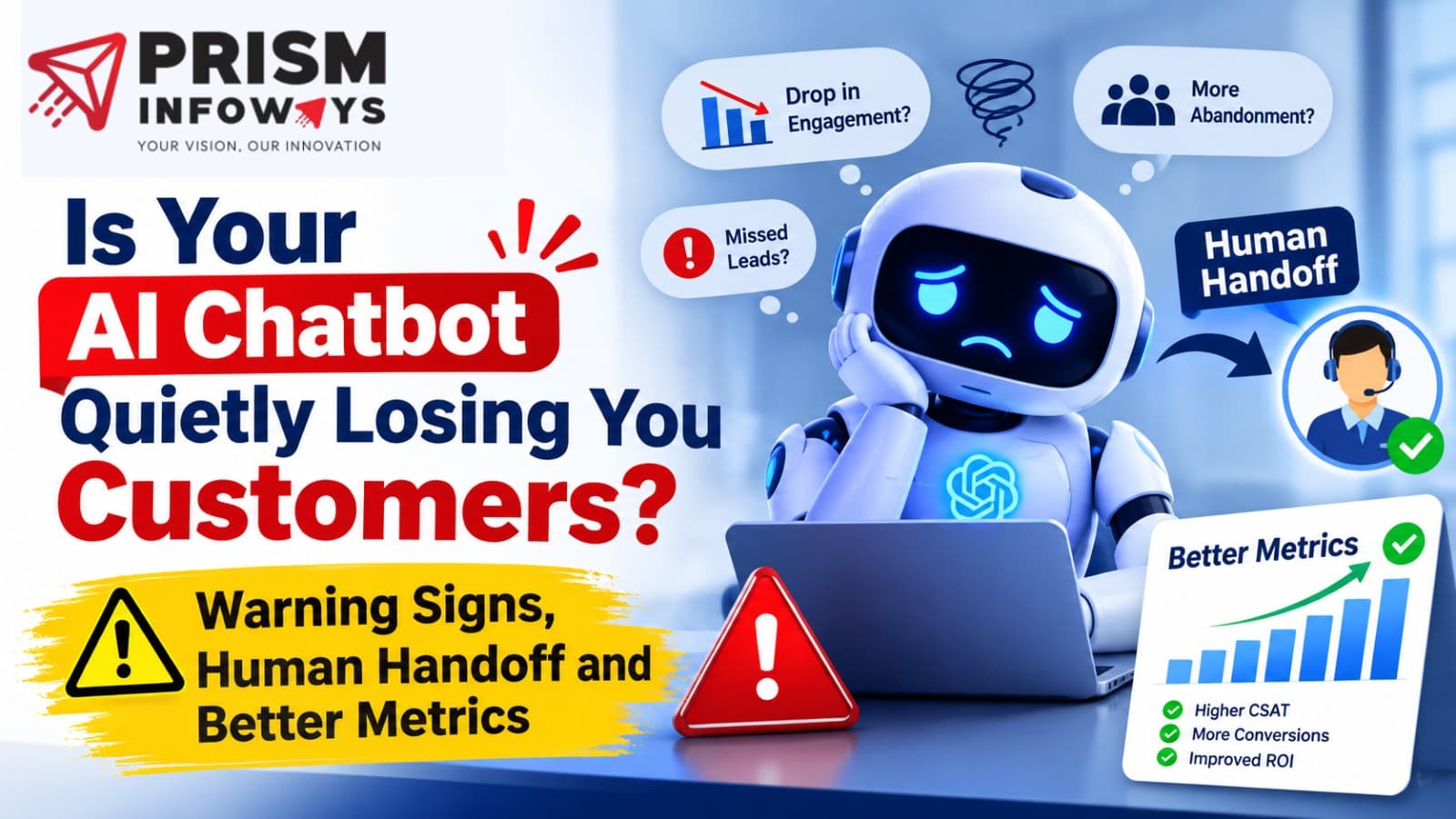
AI chatbots lose customers when they deflect instead of resolve. Learn the warning signs, when not to use a bot, how to hand over to a human, and the metrics to track instead of deflection rate.
Quick answer: Yes, it can. An AI chatbot loses customers when it is built to deflect tickets instead of solving problems. Recent surveys show that fast automated replies often leave people frustrated, and many customers say they would switch brands over poor AI service. The fix is not to remove the bot. Limit it to tasks it handles well, give customers an obvious path to a human, and measure resolution instead of deflection.
Key takeaways
- Speed is not resolution. 75% of consumers in Glance's 2026 survey got a fast AI reply that still left them frustrated.
- Deflection rate hides lost customers, because abandoned chats count as "contained."
- Keep bots on simple, documented tasks. Send billing, complaints, sales and regulated topics to people.
- Offer a visible "Talk to a person" option from the first message and pass full context to the agent.
- Track resolution rate, repeat-contact rate, time to human, post-escalation CSAT and retention.
Your chatbot answers in two seconds, works at 3 a.m. and never asks for a salary. On the dashboard it looks like a win. But dashboards count the conversations a bot closed, not the customers it helped. A person who gives up, leaves your site and buys from a competitor still shows up as a "successful deflection."
This guide explains why that happens, how to spot it in your own data, and how to fix it without giving up on automation. If you are planning or rebuilding a support bot, our AI solutions team designs automation with proper human handoff.
Why Do AI Chatbots Frustrate Customers?
Because speed and resolution are different things, and most bots are tuned for speed. In Glance's 2026 CX Trends Report, a survey of more than 600 U.S. consumers, 75% said they had received a fast AI response that still left them frustrated, and 68% named a complete resolution as the most important part of any support interaction.
The trust gap is wide. A Gartner survey of 5,728 customers, cited in an April 2026 analysis in the Berkeley California Management Review, found that 64% preferred companies not use AI for customer service and 53% would consider switching to a competitor over it. The same analysis reports that only 14% of service issues were fully resolved through self-service.
A fair caution: several of these studies come from vendors that sell customer-experience products, so treat the exact percentages as directional. Still, the pattern repeats. A May 2026 OnePoll survey of 6,000 consumers in the US, UK and Canada, commissioned by AnswerConnect, also reported growing rejection of bots in favour of human support. Customers accept AI when it solves their problem and resent it when it stands in the way.
What Design Mistakes Cause Chatbots to Fail?
Most failures trace back to a handful of design choices, and the Berkeley analysis points to the same ones:
- The interrogation loop. The bot asks a string of questions unrelated to the request while offering nothing useful in return, so the customer feels ignored.
- Overreach. Bots are given complex, emotional or account-specific problems they cannot solve, and instead of passing the customer along they keep guessing.
- Fake humanity. Customers like a friendly, natural tone, but they dislike a bot that pretends to be a person. A clear label such as "virtual assistant" sets honest expectations and builds more trust than a human name and a stock photo.
What Are the Warning Signs Your Chatbot Is Costing You Customers?
Look for these five patterns in your analytics and support data.
- Customers repeat the same question within 24 hours. Where to see it: Repeat-contact rate in your helpdesk. Usual cause: The bot closed the chat without solving the problem.
- Users type "agent," "human" or "representative". Where to see it: Keyword search in chat transcripts. Usual cause: No visible way to reach a person.
- High containment but flat or falling CSAT. Where to see it: Support dashboard compared with survey scores. Usual cause: Abandoned chats are counted as successes.
- Cancellations or refund requests rise after a chat. Where to see it: CRM and billing system. Usual cause: Sensitive requests are handled by the bot.
- Visitors leave after the first bot reply. Where to see it: Session recordings and analytics. Usual cause: Generic or wrong first answer.
None of these appear in a standard "the bot resolved X% of chats" report. You have to join chat data with tickets, billing and retention data. That extra work is where the real picture lives.
When Should You Not Use a Chatbot?
Use a bot for questions with a stable, documented answer: order status, opening hours, password resets, appointment booking and basic product details. Keep humans in front when stakes, emotions or complexity are high:
- Billing disputes, refunds and cancellations, where customers want confirmation from a person with authority.
- Complaints and urgent problems, where a scripted apology reads as dismissal.
- High-value sales conversations, where a missed nuance costs a deal, not a ticket.
- Regulated or safety-related topics, where a wrong answer creates legal or health risk.
- Anything the customer has already tried twice without success.
How Should a Chatbot Hand Over to a Human?
A good handoff has four parts. Treat escalation as the bot doing its job, not failing at it.
- A visible exit. Offer "Talk to a person" from the first message, not after five failed attempts. A bot that cannot be escaped turns a small problem into a lost customer.
- Smart triggers. Escalate automatically when the bot fails to understand twice (a common rule of thumb), when sentiment turns negative, or when words like "cancel," "refund" or "complaint" appear.
- Full context. Pass the transcript, customer details and detected intent to the agent. Vendor analysis from Macha (2026) describes forcing customers to repeat themselves as the biggest swing factor in satisfaction after escalation.
- Honest expectations. Say who the customer is being transferred to and roughly how long it will take. If nobody is available, offer a scheduled callback instead of a dead end.
Which Metrics Should You Track Instead of Deflection Rate?
Containment, or deflection, rate tells you how many chats never reached a human. It does not tell you whether the customer got what they needed. Comm100's 2025 benchmark, summarised by StealthAgents, reported that chatbots handled 73.8% of incoming chats in 2024 but resolved only 45.8%. That gap is where frustrated customers live.
Replace the single headline number with a small scorecard:
- Resolution rate: issues confirmed solved, not just conversations ended.
- Repeat-contact rate: customers returning on the same issue within seven days.
- Time to human: how long a customer who wants a person waits to reach one.
- Post-escalation CSAT: satisfaction after a human takes over.
- Retention by support path: do customers who used the bot stay as long as those who did not?
How Can You Audit Your Chatbot This Week?
You do not need a new tool. You need a few hours and an honest look.
- Read 50 recent transcripts, including some the bot marked as resolved.
- Type "agent" into your own chat widget and time how long it takes to reach a person.
- Match chat sessions to tickets, refunds and cancellations from the following week.
- Group conversations by intent and rank them by failure rate.
- Fix or remove the bot from the three worst intents, then re-measure after 30 days.
Small, measured changes beat a full rebuild.
What Does a Healthy AI Support Setup Look Like?
Think of three layers, each with a clear owner, a defined set of topics and a clear route to the next layer:
- Self-service for repeatable questions, backed by a knowledge base that someone owns and keeps current, because a bot is only as accurate as the content behind it.
- AI that assists your people instead of replacing them, such as drafting replies, summarising long threads and surfacing the right help article while an agent is on the chat. Custom machine learning models can power this layer.
- Human specialists for judgement calls, exceptions and upset customers.
This structure also protects your reputation. Frustrated customers write reviews, and public reviews can shape how both search engines and AI assistants describe your business. For help choosing the right tools for each layer, see our guide to the top AI tools for different business purposes in 2026.
Frequently Asked Questions
Do AI chatbots hurt customer satisfaction?
They can. Surveys by Glance and others show that quick answers frustrate customers when the problem stays unresolved. Bots help when they are limited to simple, well-documented tasks with an easy route to a human, and hurt when they act as gatekeepers.
What is chatbot containment rate?
Containment rate is the share of chats that end without a human agent. It misleads on its own because abandoned and unresolved chats count as contained. Pair it with resolution rate and repeat-contact rate.
Should a small business use an AI chatbot?
Often yes, for after-hours FAQs, bookings and order status, as long as complex messages reach a real person quickly. Small businesses win on personal service, so avoid hiding complaints and sales behind automation.
How many failed attempts before a chatbot hands off?
There is no universal number. Many teams escalate after two failed attempts or one clear negative-sentiment signal. A customer who asks for a human should get one immediately.
Can AI and human support work together?
Yes. The strongest setups use AI for instant answers and for assisting agents, and people for judgement, empathy and exceptions.
The Bottom Line
A chatbot should be a front desk, not a wall. It earns its place when it resolves routine questions quickly and passes everyone else to a person without friction. If your numbers look healthy but customers keep leaving, the problem is probably in what you are measuring.
Prism Infoways builds AI, web and cloud solutions for businesses worldwide. If you want an independent review of your chatbot, or help designing support automation with proper human handoff, explore our AI solutions, see our portfolio, or request a free consultation.
Need Expert IT Solutions?
Ready to transform your business? Team up with Prism Infoways and harness cutting-edge technology for your growth.
Contact Us