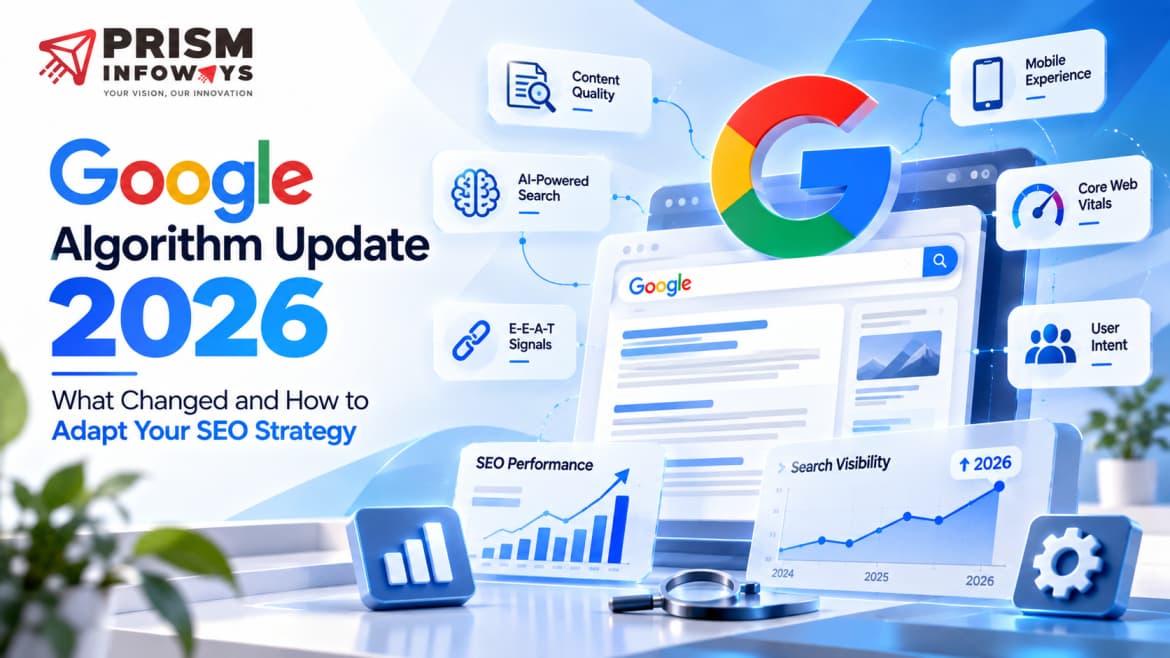
The Google Algorithm Update 2026 is really an ongoing shift, not a single event — core updates, spam updates, and the rise of AI Overviews and AI Mode are all pushing search toward genuine expertise, technical health, and content people can trust. Sites that focus on real user value, strong E-E-A-T signals, and clean technical foundations are the ones holding steady through every rollout.Keeping up with every Google update while running a business is hard to do alone. If you'd like expert help auditing your website, recovering lost rankings, or building a future-proof SEO strategy, the team at Prism Infoways offers dedicated digital marketing and SEO services to help your website stay visible, no matter how Google's algorithm changes. Visit prisminfoways.com today for a free consultation
The Google Algorithm Update 2026 has changed the rules of search visibility for millions of websites. This year alone, Google rolled out two confirmed broad core updates, three spam updates, and a major expansion of AI-powered search through AI Overviews and AI Mode. If your organic traffic has dropped or your rankings feel unstable, you are not imagining it — search results genuinely look different than they did twelve months ago.
In this blog, we break down every major Google update in 2026, explain what changed and why it matters, and share a practical, step-by-step SEO strategy so you can protect and grow your search rankings.
What Is the Google Algorithm Update 2026?
Google doesn't release just one update a year. The “Google Algorithm Update 2026” is really a series of connected changes rolled out across the year to improve search quality and adapt to how people now search using AI. These changes fall into four broad categories:
• Broad core updates – large-scale changes to how Google evaluates and ranks content overall
• Spam updates – targeted crackdowns on manipulative links, thin content, and scraped pages
• AI search changes – the rapid growth of AI Overviews, AI Mode, and Preferred Sources
• Platform changes – updates to Search Console, Merchant API, and reporting tools
Timeline of Major Google Updates in 2026
Here is a quick snapshot of the confirmed Google Search algorithm changes so far this year:
March 2026 Core Update
The first confirmed core update of 2026 ran from March 27 to April 8. Industry data showed this rollout was significantly more disruptive than the previous one, with a large share of top-three results reshuffling and many first-page pages dropping out of the top 100 entirely. Visibility shifted away from thin aggregator and intermediary sites toward stronger, more authoritative destinations.
May 2026 Core Update
Google launched a second broad core update from May 21 through June 2. This rollout landed alongside new AI performance reports inside Search Console and an expansion of the Preferred Sources feature into AI Overviews, tying core ranking quality more closely to AI search visibility.
June and August 2026 Spam Updates
Between the two core updates, Google also rolled out a June 2026 spam update (June 24–26) and an August 2026 spam update (August 18–21) — its third confirmed spam update of the year. Spam updates target manipulative tactics specifically, so if your site was affected, the fix usually involves cleaning up low-quality backlinks and thin or scraped content rather than a full content overhaul.
Merchant API Replaces Content API for Shopping
Google officially retired the Content API for Shopping on August 18, 2026, in favour of the Merchant API. Starting September 1, unapproved legacy integrations began failing intermittently. If you run an online store, confirm your shopping feed has migrated to the new API to avoid disruptions to your product listings.
How AI Overviews and AI Mode Are Reshaping Google Search
Perhaps the biggest shift in search this year isn't a core update at all — it's how Google now presents results using AI.
What Are Google AI Overviews?
AI Overviews are AI-generated summary boxes that appear above traditional results, pulling information from several web pages to answer a query directly. By 2026, they show up on roughly half of all searches and have become a permanent part of how the Google Search algorithm works, rather than an experiment. Being cited inside the overview has become more valuable than simply ranking in position one below it, since AI Overviews are estimated to reduce clicks on the top organic result noticeably.
What Is Google AI Mode?
Announced at Google I/O 2026 and described by Google as its biggest Search upgrade in more than 25 years, AI Mode replaces the traditional results page with a conversational, chat-style interface. In AI Mode, a website is either cited in the generated answer or it gets no visibility at all — there is no list of ranked links underneath. AI Mode has already crossed one billion monthly users, and interestingly, only a small share of pages cited in AI Mode also appear in AI Overviews, so the two surfaces need to be optimised as separate targets.
Why “Preferred Sources” Now Matter for SEO
Google's Preferred Sources feature lets searchers choose specific publishers they trust, and those choices influence what shows up for them in AI Overviews and AI Mode. Encouraging loyal readers, email subscribers, and social followers to select your site as a preferred source is quickly becoming a real, measurable visibility lever.
Key SEO Ranking Factors After the Google Algorithm Update 2026
E-E-A-T and Genuinely Useful Content
Google has been direct about this: optimising for generative AI search is still SEO. There is no separate “AEO” or “GEO” playbook required. What matters is Experience, Expertise, Authoritativeness, and Trust — backed by content that only your team, with your real-world experience, could credibly produce.
No Special AI Files or Extra Schema Needed
Google has also clarified that websites do not need an llms.txt file or special schema markup to appear inside AI Overviews or AI Mode. Content should be structured for real readers, not artificially chopped up to please an AI crawler.
Page Experience and Core Web Vitals
Fast loading times, mobile-friendliness, and a secure, easy-to-navigate site remain baseline requirements. They won't single-handedly boost rankings, but a poor page experience can quietly hold back an otherwise strong page.
Local SEO and Google Business Profile Activity
For local businesses, an active, review-rich, and regularly updated Google Business Profile increasingly influences visibility in the local pack, since freshness and engagement signals now carry more weight than a static, “set and forget” listing.
Step-by-Step Guide: How to Recover From a Google Core Update
If your rankings dropped after a recent rollout, work through this process in order rather than making random changes:
Step 1: Audit Your Search Console Data
Compare clicks, impressions, and average position before and after the update date, and separate Discover and AI Overview traffic from standard organic clicks so you're diagnosing the right problem.
Step 2: Compare Your Content Against Top-Ranking Pages
Study what's now ranking above you. Look for gaps in depth, first-hand experience, originality, or freshness — not just keyword usage.
Step 3: Strengthen Your E-E-A-T Signals
Add author bios with real credentials, cite credible sources, update outdated statistics, and make sure every page clearly shows who wrote it and why they're qualified to.
Step 4: Fix Technical and Page Experience Issues
Run a technical audit to catch slow-loading pages, broken links, duplicate content, and poor mobile usability — all of which can suppress an otherwise good page.
Step 5: Optimise for AI Overviews and AI Mode
Write clear, direct answers near the top of each section, use descriptive subheadings, and structure content so a specific passage can be lifted and cited accurately by AI systems.
Step 6: Monitor Weekly and Avoid Overreacting
Track rankings weekly rather than daily, and avoid panic-driven rewrites. Most genuine recoveries take several weeks to a few months to fully reflect in the search results.
Common Mistakes to Avoid After a Google Update
• Rewriting entire pages within days of a ranking drop, before you've properly diagnosed the cause
• Chasing every rumoured update instead of checking Google's official Search Status Dashboard
• Ignoring AI Overview and AI Mode visibility while only tracking traditional blue-link rankings
• Adding unnecessary llms.txt files or excessive schema markup that Google doesn't actually require
• Neglecting Google Business Profile activity if you rely on local search traffic
Frequently Asked Questions About the Google Algorithm Update 2026
1. What is the latest Google algorithm update in 2026?
As of now, Google's most recent confirmed ranking update is the August 2026 spam update, which ran from August 18 to August 21. The last broad core update was in May 2026, running from May 21 through June 2.
2. How long does it take to recover from a Google core update?
Most sites start seeing partial recovery within a few weeks, but full recovery from a Google core update can take one to three months, and sometimes longer if deeper content or E-E-A-T issues need to be fixed.
3. How does Google's AI Mode affect SEO rankings?
Google AI Mode replaces the traditional results page with a conversational answer, so being directly cited matters more than ranking position. Since AI Mode citations rarely overlap with AI Overview citations, both surfaces need separate optimisation.
4. What was Google's August 2026 spam update?
The August 2026 spam update was Google's third confirmed spam update of the year, targeting manipulative content and link practices rather than overall content quality. It ran for roughly two days and sixteen hours, from August 18 to August 21.
5. How can I optimise my website for Google AI Overviews?
Focus on clear, direct answers near the top of your content, strong E-E-A-T signals, and genuine expertise. Google has confirmed no special schema or llms.txt file is required — solid, user-first SEO remains the best way to earn AI Overview citations.
Conclusion
The Google Algorithm Update 2026 is really an ongoing shift, not a single event — core updates, spam updates, and the rise of AI Overviews and AI Mode are all pushing search toward genuine expertise, technical health, and content people can trust. Sites that focus on real user value, strong E-E-A-T signals, and clean technical foundations are the ones holding steady through every rollout.
Keeping up with every Google update while running a business is hard to do alone. If you'd like expert help auditing your website, recovering lost rankings, or building a future-proof SEO strategy, the team at Prism Infoways offers dedicated digital marketing and SEO services to help your website stay visible, no matter how Google's algorithm changes. Visit prisminfoways.com today for a free consultation
Need Expert IT Solutions?
Ready to transform your business? Team up with Prism Infoways and harness cutting-edge technology for your growth.
Contact Us